
Survival Guide for an Agentic Gold Rush: Legibility, Narrative, and People
Summary: organizations racing to deploy Agentic AI risk repeating the dot-com bust unless they first build organizational “legibility” — a clear, translatable understanding of their own strategy, culture, and people. Invest in narrative throughlines and human-AI collective design to give employees agency in the transformation.
Everyone with a website was going to be rich — that is how the internet age came in, like a wave, a gold rush driven by a new, democratizing technology — all upside for us all. While the bright-eyed dot-com boom wasn’t entirely wrong about the future, it was spectacularly wrong about the winners. Many spectacular fails began with the next big idea, like thinking people would pay a premium to get their dry cleaning, dog food, and ice cream delivered all at once.
We are in a comparable gold rush now, but it’s faster thanks to Agentic AI, and it’s expected to mine new billionaires at machine speed. If that last sentence made you feel manic, good; we need to take a pause and think, because rushing to propagate an agentic army just to handle everything we find annoying requires accepting the absurdity that you need seven AI agents to check the system’s own mistakes. This zeitgeist is existential for people and the organizations they work for. So should organizations ride this wave, let it rush over, or shape it?
Gold Rush 2026, Agentic AI.
On May 4th and 5th of 2026, I was at the NYC Agentic AI Conference in a midtown hotel, milling about with eager people, navigating a dense conference agenda and bad Wi-Fi, but otherwise focusing on the stage, hoping for some insight or validation. Beneath all the smart chatter, an industry was convincing itself there was gold to be had but only room for some to join the party.
On a massive stage, to a packed audience, one investor casually stated that some people in the workforce “just won’t make the cut,” delivering the quip with a touch of performative foreboding. I looked around the room. It was full of slightly terrified tech professionals—they wanted to be included, worthy, counted as the ones ready to change, even if they didn’t know what that entailed. I respect the calculus, but if we care about people, the new strategy should take an organizational-level perspective. The AI tide is coming in, and how we respond will determine if this wave forms our future or if we shape it.
Agentic AI: Power Shifts & Complexity.
While Agentic AI promises organizational acceleration, the path to implementation can be difficult to navigate. Human-AI collaboration shifts much of the power from humans to machines, leaving accountability largely uncharted. Even the simplest off-the-shelf Agentic AI solutions can easily add unintended complexity and demand more robust resourcing; for instance, like software development, Agentic workflows will be iterative in perpetuity.
Without a roadmap, the organization’s transformation can derail, and fear of derailment scares some away from a future none of us can avoid. Many have already sidelined their own organizations by dismissing Agentic AI as a big investment that creates broad exposure; they see the folly of a gold rush, but the wave is still forming a groundswell beneath them.
What the Dot-Com Boom/Bust Taught Me.
Looking at the Agentic landscape, I see things happening now that I have seen before, and it reminds me of past tech tumults; Agentic AI platforms have flooded the market, and new competition is piling on rapidly, but many newcomers offer agentic solutions to everything except complexity, and don’t offer assurances of cost control. They are in high demand, but there won’t be room for all of them. When organizations make high-stakes investments, they have to wonder which vendors will stick around. To cut through the hype and add some perspective, let’s take a peek at a past tech zeitgeist. While the gap between the Industrial Revolution and the Information Age was about a century, the gap from the dawn of the internet to now is much shorter. I remember enough of the previous revolution to see what I learned the hard way from a splintered, manic browser market 30 years ago, when my dial-up router was my impressive new device.
Gold Rush 2000, Super Boom XXXIV.
It is Monday, January 31, 2000. I used a phone book and a paper map to locate my new job, and a metal token to ride the NYC subway to Merkley Newman & Harty. It is the day after Super Bowl XXXIV, and the agency is giving a company-wide lunch to celebrate an extraordinarily expensive advertising extravaganza sponsored by a dozen+ fresh startups. These super scene-stealers paid an average of $2.2 million+ per spot, accounting for nearly 20% of the Bowl’s airtime, announcing themselves to millions of fans who weren’t entirely sure what was unfolding. The agency replayed the ad spots over a well-stocked taco buffet. We cheered. We laughed at the E*Trade monkey. We admired the Pets.com sock puppet like it was a small celebrity, and we thought everyone in tech was going to win; we couldn’t have imagined that most startups would fail.
I wasn’t building a startup; I thought I was too smart for that; I was along for the ride. I had a temporary desk crowded with an established Mac and an interloping PC I didn’t think I needed. My job focused mostly on print, though my imagination was consumed by digital, yet I wasn’t preparing for the future because I thought I was already in it. Same for Pets.com, monster.com, and all the ad people who thought the transition from print, radio, and TV to screens would be a cut-and-paste. The real future, when it came, would not be easy.
The Browser Wars, 1994 — 2022.
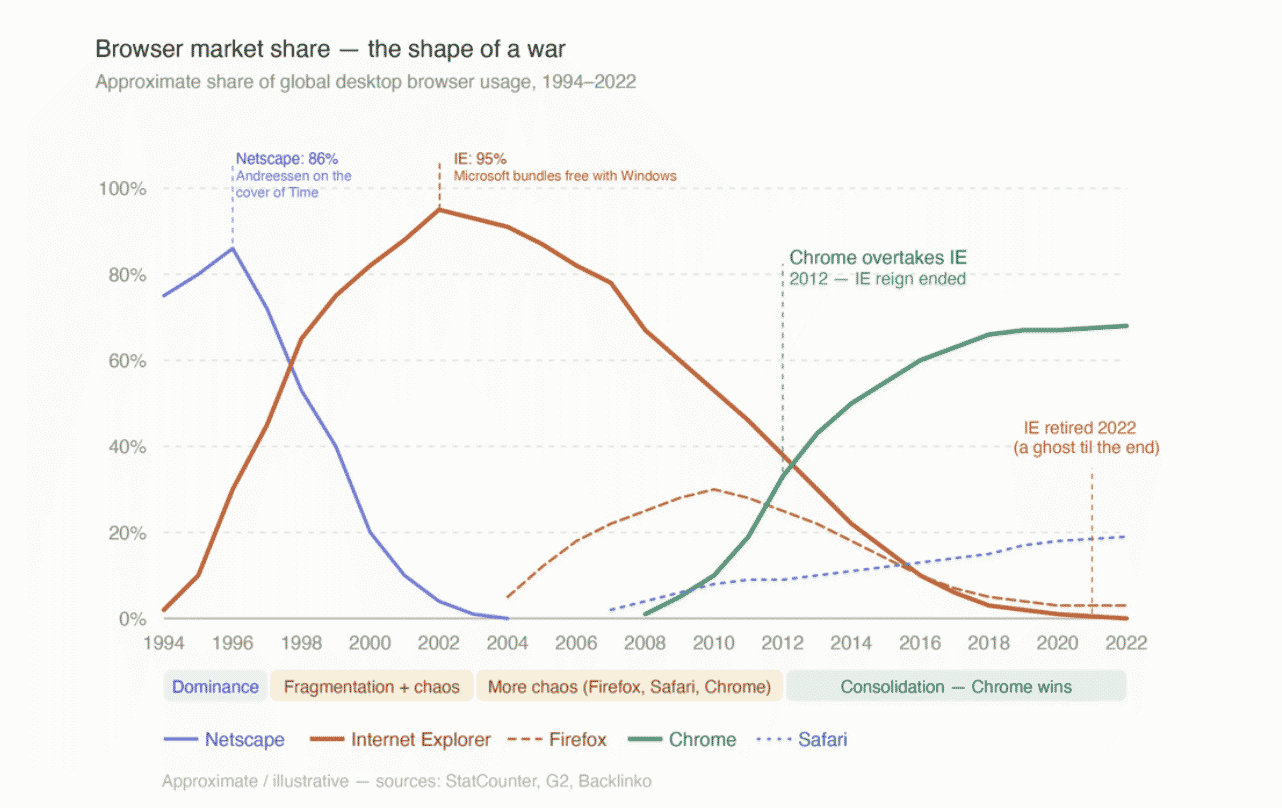
In the 90’s, early adopters dialed up the browser that would capture the largest market share in mere months: Netscape Navigator, and if you were building websites, it was simple and glorious: one browser to build and test, and millions of people to engage, but the fun was short-lived. Microsoft bundled (imposed) Internet Explorer with Windows 95, and the compatibility headaches began. I had to account for the PC user’s operating system, multiple browsers, and human behavior in a mutable digital medium. By 1999, everyone was building and testing at least two versions of every website because no rules existed—browsers were never incentivized to render the same code uniformly. I learned quickly that we can only get so far with people if we reduce usability to the statistical norm.
Despite the challenges, adoption kept growing, and the browser market splintered further: Firefox, Safari, Opera, Chrome… More global adoption meant more browser dialects; it got rough, and there wasn’t room for everyone. Even IE, once the developers’ darling, was retired in 2022, after spending its final years as a zombie that under-resourced, risk-averse IT departments couldn’t risk killing, and the war raged on. As I learned 6 code languages in 5 years and had more ‘yes, your website looks different on different devices‘ conversations, and more arguments about how many audiences we could scope for and which to leave behind, my exuberance faded, and I cursed the protectionism of proprietary systems.
The chat below depicts some of this tumult:
It’s 2026, and I am Not Just Along for the Ride.
I can now look back on all the things that kept me up at night, fondly. When I was forced to build two versions of the same thing over and over, I had to ask new questions, not about technology, but about people. Do people view websites differently on the same devices? How can individuals with impairments use this medium? How do I translate everything there is to say about an organization into a website? I became a better team leader not by mastering the tools, but by learning to pursue unknowns with new questions that took me places I never thought my career would see, and I became a grateful translator of narrative.
This Agentic AI moment offers the same infuriating challenges and inspiring opportunities as the aughts did. The tension between tech and humans now asks how we translate people and their objectives to reasoning machines instead of websites. At FormWave Collective, we call this translation legibility, and you can learn more here.
This time around, I am not just along for the ride, but I am not rushing in, either; the Age of Agentic AI gives me pause to consider all the upside that the tide is bringing, making way for the new.
Opportunity: Liberation from SaaS.
Every revolution forces out old standards, followed shortly by a certain amount of hype that seems to outpace reality. My partner, Derrick Cash, has written a piece that takes down the temperature on the potential fate of SaaS (Software as a Service) here, and one of the bright spots he calls out is our future liberation from proprietariness (yes, I made up a word): total freedom from having to know all the commands, all the tools, and all the quirky icons to get work done.
Someday soon, thanks to Agentic AI, people jumping between dozens of SaaS products just to do their job will no longer need to spend much time translating the quirky icons of any User Interface.
Imagine what people will do with their time once it’s no longer dominated by UI gymnastics! At a law firm, for instance — all the new time to think, imagine, and invent once lawyers are liberated from the doc review.
SaaS liberation is possible because AI translates proprietary tech dialects instantly, leaping over tall systems in a single bound and torpedoing the walls of protectionism. The expert brings their experience, and the Agents wrangle the stack. Go tell your team they will never have to open the CRM again, and watch what happens. System liberation will be the most popular part of the transformation, but don’t rush in by spreading a thin layer of tokens over everyone; they will just prompt their way into the shadows and out of compliance. They will have fewer incentives to work in teams and will miss, rather tragically, humanity’s moment for better, more intelligent collaboration, ironically brought to shore by AI.
This moment demands that we leave our fiefdoms, stop running in place, and explain ourselves to ourselves, and then to machines. Though many culture traps will pepper the path, an AI Transformation doesn’t need to stall at the MVP or leave anyone behind; people need to discover a frontier to believe in, because human obsolescence is more existential and less Sci-Fi now, and ironically, as sophisticated as Agentic AI is, the machines we designed to think like humans and simplify our lives, off the shelf, are dumb and complex.
Problem: Observability, Complexity, and Culture.
McKinsey’s 2025 State of AI report finds that 62% of organizations are experimenting with or scaling AI agents, yet only 6% qualify as AI “high performers” achieving significant enterprise-wide EBIT impact. The causes are many, but all are undercut by one reality: AI functions by guessing along a non-observable probability gradient — a mysterious haze of potentiality not unlike an electron’s position in space before observation. AI does what it does, and you face a gauntlet of inexplicable mistakes, hallucinations, bias, and jailbreaks in the outputs.
Agentic workflows are designed to reduce head-scratching outputs; to do this, they have to be redundantly redundant—any one layer of an agentic system may involve 5+ agents and several models: pulling, parsing, validating, coordinating, scoring, and consuming resources at machine speed. And while agentic AI can self-check and self-learn, the machine reasoning remains unseen, threatening organizational adoption. Risk persists while ROI remains elusive because the organization didn’t take the time in the design phase to understand itself — I know this because it happens too often in any initiative, like a product launch, leadership transition, or brand relaunch. An organization needs clarity on strategy, process, governance, culture, and, most of all, brand to communicate meaningful, supportive new norms and avoid derailment.
We at FormWave recommend that an organization redesign systems to amplify values. By designing your legibility and building meaningful narratives, human and machine systems can be reorganized into intelligent, AI-aided collectives.
Investment in AI, Agentic or otherwise, can be significant, but so can the payoff. According to McKinsey, in the second edition of Rewired (May 2026), the upside of an AI transformation is 3X EBITDA (Earnings before interest, taxes, depreciation, and amortization), but McKinsey also cautions that derailments are predictable in AI initiatives, some of which they call death by use case — but if not the use case, then where to begin? We naturally default to what we know and ask the wrong questions, like ‘build it or buy it?’, when more instructive questions may be: ‘What roles will people play if we automate most of what they do now?’ It is time to ask new questions: the future is now, and the people question is existential.
Brand is a Collective Survival Story.
Bees have survived for 130 million years. They have compound eyes made up of thousands of individual lenses, allowing them to detect many dimensions of change in their environment. They are collectives of distributed intelligence to meet the hive’s demands and adapt as needed.
An Agentic AI Transformation demands a lot: new process knowledge, risk assessment, organizational culture change. Organizations need to try many new things, but first they need to understand themselves. They need to design their legibility, as we like to put it at FormWave — to know their own dimensions well enough to translate themselves to machines. Bees don’t wait to be told what the hive needs; they read a thousand small signals and act on them together. That’s the instinct a company needs before it can survive its own transformation.
In my years as a brand professional, translating organizations to audiences across many channels and diagnosing the gaps between business objectives, brand promise, and audience expectation, I’ve found that most companies struggle to describe what they do — both externally and internally.
Externally, the brand falls short when its features and benefits don’t meet the audience’s actual pain points. Sometimes that’s simply a matter of perspective: an outside eye can surface value a company already has but can’t see in itself. More often, though, the gap is self-inflicted. Leadership has invested time, money, and reputation in strategy built from company IP alone, without audience sentiment, domain reputation, competitive pressure, or their own team’s expertise in the room.
Internally, the brand fails for a related reason: the organization can’t see itself either. When money is the only thing that gets measured, money becomes the only thing that gets valued. The problem is structural. Departments aren’t designed to collaborate; they’re designed to defend. They spawn ecosystems that hoard tacit knowledge, protect turf, and keep workloads and complexity contained.
An organization like this has no story to tell itself, let alone its people. When change arrives — an AI wave — it doesn’t hit a story. It hits entropy. Performance improves when people feel seen, when they belong, when they recognize themselves in the story the brand tells. But you can’t brand what you cannot see. Organizations need observability into their people to build that belonging and safety, because people, like machines, can produce head-scratching outputs. But people hate surveillance. That conundrum forces a new question:
What would happen if we measured the value of people in more than money?
Branding Activates the ‘Why’ Throughline.
The adage “garbage in, garbage out” applies to AI—of course, a thorough examination of business processes should inform change—but culture also needs better ingredients. Instead of tracking performance only by money in and money out, we can leverage myriad other meaningful, machine-trackable data, restructure KPIs and OKRs around culture signals, incentivize teams as well as individuals, and design narratives to create throughlines from business strategy to people.
The throughline socializes the unprecedented; in other words, transporting a strong “why” that brings everyone together while their work processes get an exponential lift from Agentic AI. At FormWave, we see AI’s real value proposition in emotionally intelligent collaboration—people and machines—or the collective. (See MIT on Collective Intelligence.)
Outcome: Agency for People to Form the New Frontier.
People-Agentic workflows, or collectives, reduce risk by increasing the observability of both AI and people, done as a live dialogue rather than a pipeline. People and machines teach each other in the open, each correcting the other, reflexive and cooperative by design.
These collaborations come with real trade-offs: recent field experiments show Human-AI collaboration can boost output while narrowing its range, so the division of labor matters on many levels. Machines reason and execute; people bring nuance, judgment, creativity, and accountability — the range that keeps a collective from collapsing into sameness. Upskilling can be daunting, but a strong brand narrative turns cross-functional teams into energized collectives.
Rather than human obsolescence, here is what I believe: most people who don’t make the cut will opt out, not because they couldn’t learn the tools, but because power is shifting from people to machines, and they’re left accountable for decisions they no longer feel they control. Agentic workflows built with people in the room can distribute authority across the collective while keeping people at the helm. Agency is what turns accountability into something people choose.
The ROI is not just about productizing data and making it reusable for groups; it is about making the work whole again. We need to do what humans have always done to face change at scale: tell stories that matter. When people see their new role in a powerful story, they gain the agency to shape the waves of change coming at them and to form a frontier they can believe in.
Your Organization’s Golden Question.
This is what we’re building at FormWave Collective — roadmaps through legibility diagnostics, narrative throughlines, and human/machine system design.
As your organization faces the Agentic AI wave, we challenge you to shift your mindware to ask new questions about what is now possible that wasn’t before.
Now is the time to be legible, tell a powerful story, build value around people, leap over proprietary systems, and ask: What can we do to transform beyond automation? To transform the organization…
…What can we do to transform the sector we reside in?
Challenges lie ahead, but the lessons will be instructive. Don’t start with an Agentic stack. Instead, structure your teams and machines to give your people the agency to shape the incoming wave—stake your claim by empowering people in the organization to form the frontier.
CITATIONS:
Agentic AI Conference, Schedule — AgentConference.com
Dot-Com Commercials During Super Bowl XXXIV — Wikipedia
Dot Com Ads as a Bubble Warning, 2026 — Acadian Asset Management
Merkley+Partners — Merkley+Partners
Pets.com — Wikipedia
14 Dot-Com Companies Had Super Bowl Commercials in 2000 — Here’s How Many Still Exist — Benzinga
Netscape Navigator — Wikipedia
Global Browser Market Share: Desktop Browsers Timeline — gs.statcounter.com
Designing Your Legibility, Palmer Foote (2026) — FormWave Collective
SaaS vs SaS, Derrick Cash (2026) — FormWave Collective
The State of AI Report: 2025 Agents, Innovation, and Transformation — McKinsey & Company
Rewired 2.0: How Leading Companies Are (Still) Winning with AI, McKinsey & Company (2026) — McKinsey
The Beguiling History of Bees, Scientific American — Scientific American
Do Bees Have a Hive Mind? The Science of Bee Colonies, Biology Insights, August 2025 — Biology Insights
MIT Center for Collective Intelligence — MIT
Collaborating with AI Agents, Ju & Aral (2026) — MIT/Johns Hopkins

Author: Christa Bianchi | Partner: FormWave Collective
The FormWave Journal articles represent the shared thinking and lived experiences of the FormWave Collective—a collaboration of professionals committed to surfacing signals, shaping what moves us, and reframing the future of work.
To get alerts to your inbox about future articles, sign up below.
Designing Your Legibility
Summary: The article uses the author's 30 years managing type 1 diabetes as a lens for a broader framework called "legibility"—how much context outsiders need to understand something, and who controls that translation. Drawing on James C. Scott's Seeing Like a State,...
From SaaS to Service as Software
Summary: In this article, AI Strategist Derrick Cash breaks down the rise of Service as Software (SaS), why the familiar seat-based SaaS model is under structural pressure, and what the leaders who get ahead of this shift are doing differently.Why the SaaS Industry Is...
FWC Podcast SaaS vs SaS
FWC PODCAST EPISODE #2 You've invested in the SaaS stack. Salesforce. HubSpot. Workday. ServiceNow. And yet — work is still slow. The tools are there. The budget was spent. So what's actually broken? In this episode, Palmer, Derrick, and Christa sit down to cut...
Should Organizational Culture Be Comfortable with Judgment Automation?
Summary: Judgment automation and agentic AI are reshaping organizational culture by exposing human bias and redefining decision-making. This article explores how businesses can align narrative, leadership, and systems design to build collective intelligence, improve...
FWC Podcast: Plurality vs Intelligence
FWC PODCAST EPISODE #1 Plurality Isn’t Chaos, It’s Capacity In our first episode of the FormWave Collective Podcast, we revisit Leviathan by Thomas Hobbes to confront a timeless fear: that too many voices lead to collapse. But in today’s Intelligence Age—defined by...
The Rituals of Readiness: Trust, Meaning, and Cultural Change in the Age of Intelligence
This essay looks beneath those categories into the social and symbolic patterns that make alignment possible in the age of intelligence. While capability can be measured, alignment must be felt. That feeling of trust, participation, and belonging is not built through metrics but through rituals. Rituals are how humans metabolize change.