
The headline was frightening. The more important story was underneath it.
On October 21, 2026, the PHP project released emergency security patches for two critical vulnerabilities, collectively nicknamed PHP2Shell, that could allow attackers to execute code remotely on vulnerable web servers without authenticating.
PHP sits underneath roughly two-thirds of websites whose server-side programming language is known, including the millions of websites built on WordPress. The National Security Agency urged organizations to patch immediately or, where adequate mitigation was not possible, take affected systems offline.
The scale of the potential exposure was alarming. But the more consequential story was how the vulnerabilities were discovered, how long the underlying weaknesses had existed, and what that tells us about the future of cybersecurity in an AI-enabled world.
A quick primer on PHP.
PHP is an open-source programming language that runs on web servers, processing information and dynamically generating content as visitors interact with websites and applications. Created by Rasmus Lerdorf in the mid-1990s, it now underpins WordPress, Drupal, Joomla, Wikipedia’s MediaWiki, and countless custom business applications, hosting platforms, and technology products. According to W3Techs, as of November 25, 2026, PHP powers 67.9% of websites whose server-side programming language can be identified.
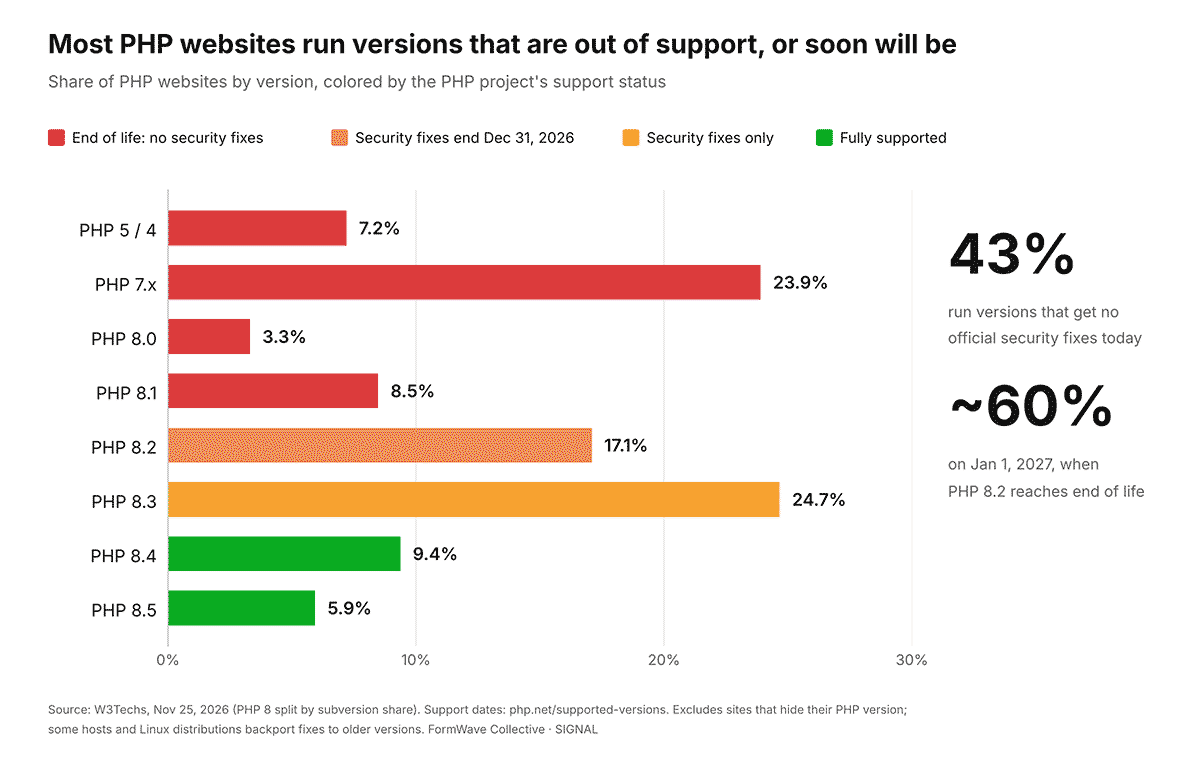
PHP is maintained by an open-source community, with core development supported by the nonprofit PHP Foundation. Under its current release model, each major release branch receives two years of active support followed by two years of security-only support. After that, it reaches end-of-life, and the PHP project no longer provides official security fixes for that branch.
And here is where the numbers become particularly interesting:
Roughly 43% of PHP websites with a detectable version run a release that no longer receives official security fixes. On January 1, 2027, when PHP 8.2 reaches end of life, that figure rises to roughly 60%.
For the organizations behind those sites, the implication is straightforward: there is upgrade work to do. It is rarely a single switch. Themes, plugins, integrations, and custom code need to be tested against the newer version first. Some organizations receive extended coverage through commercial providers or Linux distributions that backport fixes; many others are running software whose original maintainers no longer support.
This is not a PHP-specific problem. It is a small window into the accumulated technical debt of our digital infrastructure.
What actually happened.
Security researchers independently discovered the publicly disclosed vulnerabilities using frontier AI capabilities.
Calif, working through OpenAI’s Patch the Planet initiative, identified a critical weakness. Wiz independently discovered and reported both vulnerabilities, while OpenAI contributed additional research. The PHP maintainers led remediation, working alongside researchers, infrastructure providers, and security companies to prepare fixes and protective measures. Cloudflare deployed preventive firewall protections. Managed hosting providers such as Kinsta implemented mitigations and rapidly rolled out updated PHP versions.
In many respects, the defensive ecosystem demonstrated exactly the kind of collaboration we should want to see.
But the coordinated response was not without its complications. Information began circulating ahead of the planned release, forcing the PHP team to accelerate disclosure. Amazon Threat Intelligence subsequently reported observing an exploitation attempt on October 17—four days before the official patches became available.
We cannot conclude from that observation alone that the attacker used AI. What we can conclude is that defenders were already operating against an active threat before the broader public knew a patch was necessary.
So, lower the temperature on the sensationalism, but not on the seriousness of the threat.
PHP2Shell demonstrated both the power of AI-enabled cyber defense and the increasingly compressed window within which organizations must respond.
The part worth losing sleep over.
The uncomfortable detail is not that AI found a bug. It is that people saw the underlying problem years ago.
In 2024, following an external security audit of PHP, a core developer identified early indications of the memory-management weakness behind one of the PHP2Shell vulnerabilities. The possibility of exploitation was considered, but researchers had not demonstrated a practical path to remote code execution. Potential fixes introduced difficult trade-offs involving compatibility, performance, availability, and the broader third-party software ecosystem. Competing priorities, limited specialist resources, and challenges reaching consensus caused remediation efforts to stall.
The PHP Foundation would later characterize the delay as a “structural failure” involving both decision-making and resourcing. Just two years later, AI-assisted researchers crossed a gap that had proven difficult for human experts to resolve. AI did not create the weakness. The underlying condition was already observable. AI helped change our ability to understand what that weakness could become, interpret its consequences, and show that those consequences were actionable.
That is the real shift.
Automation has existed in cybersecurity for decades. Vulnerability scanners, automated penetration testing tools, and threat detection systems are nothing new. Yet some of the hardest work still depends on scarce human expertise: examining complex systems, tracing obscure software behavior, constructing hypotheses, testing assumptions, and recognizing relationships others have missed. Frontier AI is beginning to compress that investigative process. Capabilities that previously required substantial specialist expertise and investigative effort are becoming more accessible, scalable, and repeatable. And that changes the economics of cybersecurity for both sides.
Consider how challenging it was to secure an organization before these capabilities existed. Security teams were already struggling to inventory assets, monitor networks, evaluate vulnerabilities, manage identities, coordinate patches, conduct assessments, educate employees, and keep pace with evolving threats—all while supporting the business’s day-to-day operations.
Many organizations were falling behind even then.
Now imagine performing those same responsibilities in an environment where AI can uncover weaknesses that experienced security professionals could not previously fully characterize. The challenge is not simply that there will be more vulnerabilities to address. It is that the time organizations have to understand and respond to them may become considerably shorter.
PHP2Shell was not an isolated event, either. On November 19, less than a month after the initial emergency release, PHP published another round of security updates addressing numerous vulnerabilities, including seven classified as critical. Among them was a weakness associated with an incomplete fix for one of the original PHP2Shell vulnerabilities. The emerging challenge is not one large fire. It is a sustained cadence of discovery, remediation, and reassessment that traditional maintenance practices may struggle to accommodate.
Your stack already has its PHP2Shell.
Every established organization carries some degree of accumulated technological risk. The outdated runtime nobody owns. The plugin last maintained three years ago. The departmental application a departed employee built in 2002. The firewall replacement that repeatedly lost budget discussions because nothing was visibly on fire. The business-critical integration that continues to operate despite nobody fully understanding how it works.
These are not necessarily failures of technology. They are often the accumulated consequences of organizational decisions—or the absence of them. Years of deferred investment, fragmented ownership, and competing priorities are now meeting increasingly capable tools that can investigate systems at unprecedented speed and scale.
At FormWave Collective, we distinguish between observability, legibility, interpretability, and the organizational capacity to act.
- Observability is our ability to see what is happening within an environment through monitoring, inspection, telemetry, and investigation.
- Legibility is our ability to organize what we observe into a coherent picture: what exists, where it resides, how it is connected, and who owns it.
- Interpretability is our ability to understand what that picture means within a particular context: what is exposed, what matters, what could fail, and what the operational or business consequences might be.
- Action is our ability to apply that understanding—to investigate further, prioritize, allocate resources, remediate, and verify outcomes.
These are not strictly sequential activities. Action occurs throughout the process. Each intervention generates new observations, improves our understanding and informs subsequent decisions. It is a continuous learning and adaptation cycle, not a one-time assessment.
PHP2Shell illustrates what happens when an organization’s capacity to observe a problem exceeds its capacity to fully interpret and resolve it—and what can happen when a new technology suddenly accelerates that understanding. An inventory alone does not secure an organization. Neither does a dashboard, a vulnerability assessment, or an AI model. Security depends on the organization’s ability to translate what it learns into meaningful, timely, and sustained action.
Security is an organizational capability.
Two lessons from PHP2Shell deserve particular attention from organizational leaders.
Patching closes a vulnerability. It does not necessarily undo a compromise.
If someone gained access before a patch was applied, updating the software does not automatically remove unauthorized changes, compromised credentials or mechanisms that allow continued access. Remediation must include appropriate investigation, containment, recovery, and verification. The objective is not simply to demonstrate that a patch was installed. It is to establish confidence that the environment is secure.
IT cannot carry this responsibility alone.
The PHP Foundation’s acknowledgment of its own structural challenges offers an important lesson for every organization. Vulnerabilities persist when ownership is unclear, specialist resources are constrained, decisions cannot be made efficiently, or lifecycle investments repeatedly lose priority to more visible business demands. Security teams can identify and communicate risk. But organizational leadership determines whether the resources, authority, processes, and incentives exist to address it. Cybersecurity is therefore not exclusively a technical challenge. It is a function of organizational design, governance, and operational resilience. AI may accelerate our ability to discover problems. It does not automatically accelerate our ability to make decisions about them. That gap deserves as much attention as the technology itself.
What to do differently.
The appropriate response to PHP2Shell is neither fear nor avoidance of AI. It is to reconsider whether our security operating models are designed for the environment we now find ourselves in. Start with five questions:
- Do we know what we are running? Every application, server, service, dependency, and critical technology component should have an identifiable version, lifecycle status, and accountable owner—including the systems we have stopped thinking about.
- Do we understand what matters most? A vulnerability’s technical severity is only part of the equation. Internet exposure, data sensitivity, business criticality, system dependencies, and existing security controls all influence the actual organizational risk.
- How quickly can we act, and who has the authority to decide? If critical security decisions depend on quarterly maintenance schedules, prolonged approval processes, or someone eventually finding time to address them, those processes may themselves constitute a significant source of risk.
- Are we using AI to examine our own environment before someone else does? Organizations should evaluate authorized, controlled AI-assisted vulnerability discovery, code analysis, threat detection, and remediation capabilities, supported by appropriate human oversight and validation.
- How do we know that our actions worked? Measure more than the number of vulnerabilities found or patches installed. Understand how quickly exposures are discovered, how long critical risks remain unresolved, whether remediation was effective and whether similar weaknesses are recurring elsewhere.
The objective is not to replace cybersecurity professionals with AI. It is to equip them with better capabilities while redesigning the organizational systems in which they operate.
Lower the temperature. Raise the floor.
PHP2Shell should not send organizations into a panic. Nor should the availability of a patch provide a false sense of reassurance. The event is a signal of a broader transformation: AI is changing how quickly weaknesses can be discovered, understood, and acted upon. Organizations cannot control the pace at which external capabilities advance. They can, however, control how they prepare, invest, govern their technologies, and translate knowledge into action. The next PHP2Shell may already exist somewhere in your technology stack – not necessarily in PHP, and not necessarily as a weakness anyone has yet recognized. The advantage will increasingly belong to organizations that make their environments observable, legible and interpretable, and that possess the organizational capacity to act on what they learn. Lower the temperature on the headline. Raise the floor on the operating model.
Sources and further reading.
Primary research and vulnerability discovery
- The PHP Foundation — Today’s PHP Security Release, and How We’re Strengthening PHP Security · October 21, 2026. The Foundation’s account of the vulnerabilities, the underlying issue identified in 2024, remediation challenges, organizational shortcomings, and changes to its security operating model.
- OpenAI — Patch the Planet: Global Response Coordination as Agents Uncover Critical Vulnerabilities · October 21, 2026. First-party account of AI-assisted discovery and coordinated remediation.
- Wiz Research — PHP2Shell: AI Uncovers Critical RCE Vulnerabilities Affecting 70% of the Internet · October 21, 2026. Independent vulnerability discovery, technical research and implications of AI-assisted cybersecurity investigations.
Government advisories and observed threats
- National Security Agency — Critical Patches Recommended for PHP Vulnerabilities · October 2026. Federal guidance on remediation and mitigating exposure.
- AWS Security — Amazon Threat Intelligence Identifies PHP2Shell Exploitation Prior to Public Disclosure in MadPot · October 2026. First-party threat intelligence documenting exploitation attempts before public disclosure.
- Wiz Research — PHP2Shell: Exploitation Attempts and Remediation Trends · October 2026. Analysis distinguishing observed exploitation attempts from confirmed successful exploitation.
Infrastructure response and subsequent vulnerabilities
- Cloudflare — Protections Against the PHP2Shell Vulnerability · October 2026. Infrastructure-level mitigations and coordinated defensive measures.
- Kinsta — Inside Kinsta’s Emergency PHP2Shell Patch Rollout · November 2026. An operational account of emergency remediation within a managed hosting environment.
- Wiz Research — phpAfterShell and Critical PHP RCE Vulnerabilities: Everything You Need to Know · November 19, 2026. Analysis of subsequent vulnerabilities, including issues related to the original PHP2Shell fixes.
- PHP Project — Official Security Advisories · Original vulnerability disclosures and subsequent security advisories.
Technology adoption and lifecycle management
- W3Techs — Usage Statistics and Market Share of PHP for Websites · Data accessed November 25, 2026.
- W3Techs — Historical Trends in PHP Version Adoption.
- PHP Project — Supported Versions · Official support and end-of-life schedules.
- PHP Project — Official Release History · Version history and security releases.