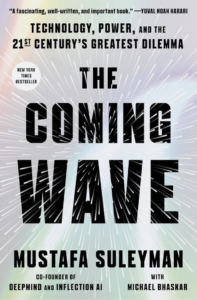
Book Review: The Coming Wave: Technology, Power, and the Twenty-first Century’s Greatest Dilemma (2023), later republished as The Coming Wave: AI, Power, and Our Future, is by Mustafa Suleyman and Michael Bhaskar. It’s a book about how humanity should meet the coming wave by walking a narrow path between catastrophe and dystopia.
Mustafa Suleyman has spent 15+ years in rooms with the top minds in AI, heads of state, tech giants, and London pub-goers, talking to anyone who will listen about AI’s potential benefits and threats. Suleyman narrates the audiobook version of The Coming Wave himself, and you can hear a lot of nuance in his reading. The argument is calm and rational, but his voice carries a plea. He is speaking to readers caught in what he calls the “pessimism aversion trap,” or the reflex to look away from worst-case outcomes. This book asks us to look at the real chance of catastrophe, the need for containment, and what safety might actually look like, if possible.
Suleyman names four features of AI that call for containment:
- Asymmetry. Very few resources, skills, or access can produce a massive impact.
- Hyper-evolution. The technology improves and spreads at an accelerating pace.
- Omni-use. One general-purpose technology applies across many tasks, industries, and problems.
- Autonomy. The technology can work out how to reach a complex goal and act on it with no human in the loop.
Suleyman applies the containment question to these four features in nine example questions. Here is how I read them.
- Is it general-purpose or specific? The more general it is, the more unknown unknowns it carries.
- Is it moving from atoms toward bits? You can fence in physical, observable things. Intangible ones slip through.
- Are price and complexity falling, and how fast? Easier to buy and easier to learn means democratizing, yes, but also harder to hold back.
- Are viable alternatives ready to go? Is something safer and nearly as good already on the shelf, e.g., cellulose, fiberglass, or mineral wool instead of asbestos?
- Does it enable asymmetric impact? Little input, massive output.
- Does it act autonomously? Can it act without us in places without oversight?
- Does it confer outsized geopolitical or economic advantage? Follow the money. Advantage moves states and institutions, and it tempts people toward ambition and bad behavior.
- Does it favor offense or defense? If attacking is cheaper than defending, the attackers set the pace.
- Are there resource or engineering constraints? Bottlenecks are among the few levers left. With AI, the bottlenecks are compute: chips, energy, and the supply chains behind them.
A thoughtful plea for us to embrace ‘the narrow path’
Look away, and catastrophe becomes likely. Hand it off to regulators, and we place our fate on the slowest vehicle for change. Clamp down as hard as we can, and we create the surveillance state we were trying to avoid. History tells us which way we tend to lean; we have traded freedom and truth for order before, and one catastrophe could make a totalitarian answer feel like relief. Suleyman makes a lengthy case for avoiding catastrophe and dystopia by planning for containment. Coming from a co-founder of DeepMind who now runs Microsoft AI, the plan is also an admission: some technologies are too useful, too cheap, and too widespread to refuse. The wave is in motion; we need to plan for how we meet it.